Table of contents
Where is Salar de Uyuni and what makes it unique
The Salar de Uyuni is located in southwestern Bolivia, in the department of Potosí, on the Andean Altiplano, at an average altitude of around 3,650 metres. With a surface area of approximately 10,582 km², it is the largest salt flat in the world and one of the most extraordinary natural landscapes in the South American continent.
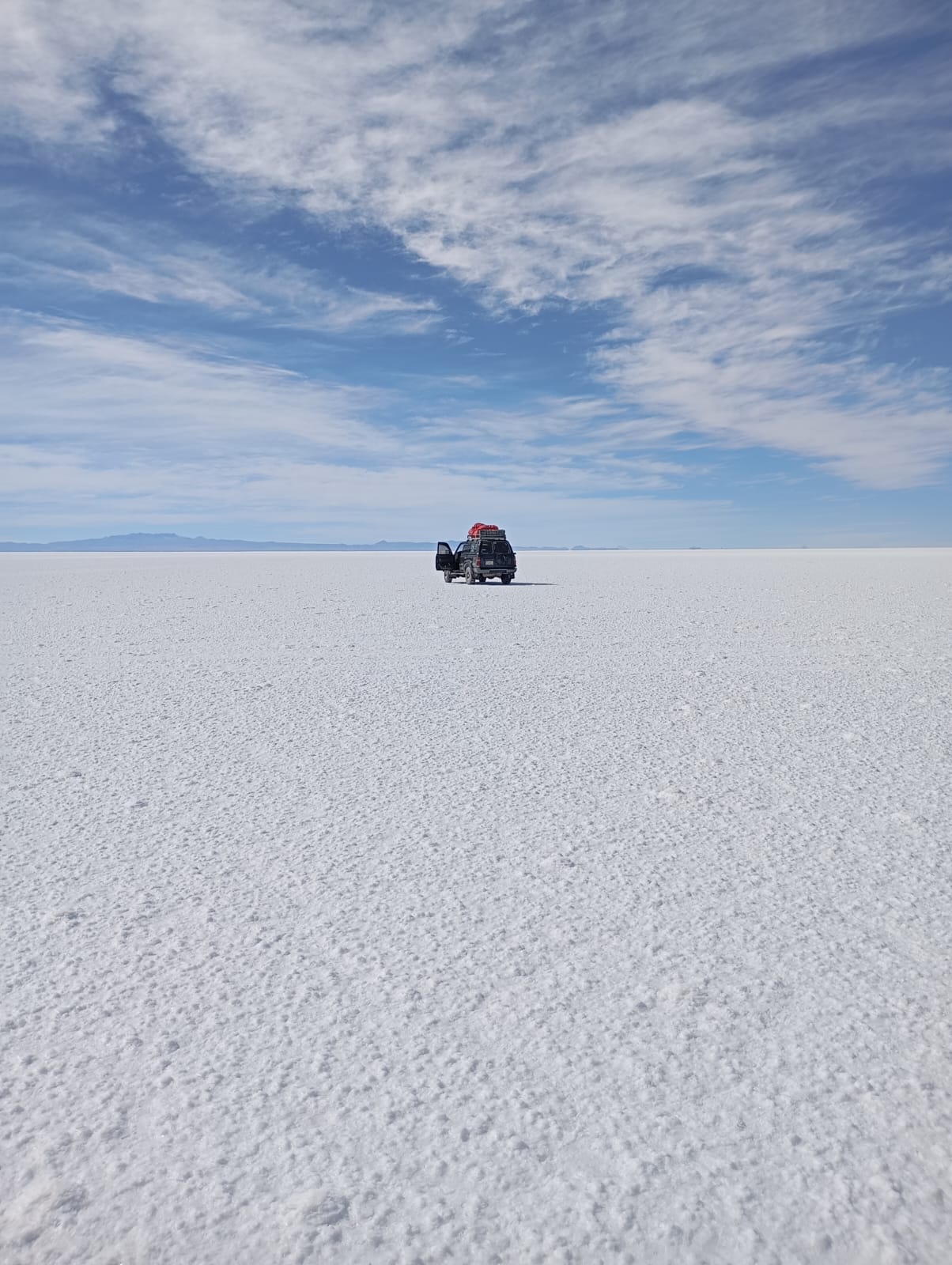
Its origin dates back thousands of years, when the evaporation of ancient prehistoric lakes left behind an enormous deposit of salt and minerals. Today, the salar appears as an immense white plain, characterised by a vastness that is difficult to fully perceive until you are standing within it.
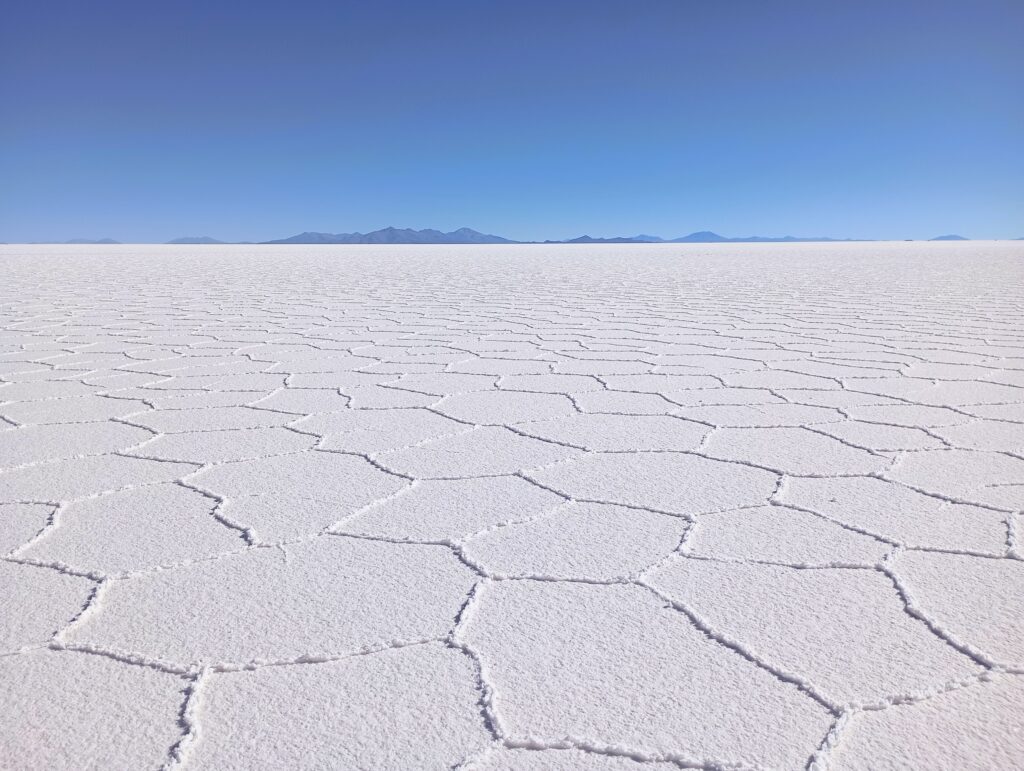
One of the most fascinating aspects of Salar de Uyuni is the way it changes throughout the year: during the dry season, the salt-covered surface displays its characteristic natural geometric patterns, while during wetter periods, a thin layer of water can transform it into a huge mirror capable of reflecting the sky.
Surrounded by volcanoes, high-altitude lagoons and vast plains of the Altiplano, Salar de Uyuni is one of the most unique natural environments in the world.
⟶ If you want to learn more about the geological background of Salar de Uyuni and its formation, you can find a dedicated guide on the origin of this vast salt flat.
Visiting Salar de Uyuni: what to expect
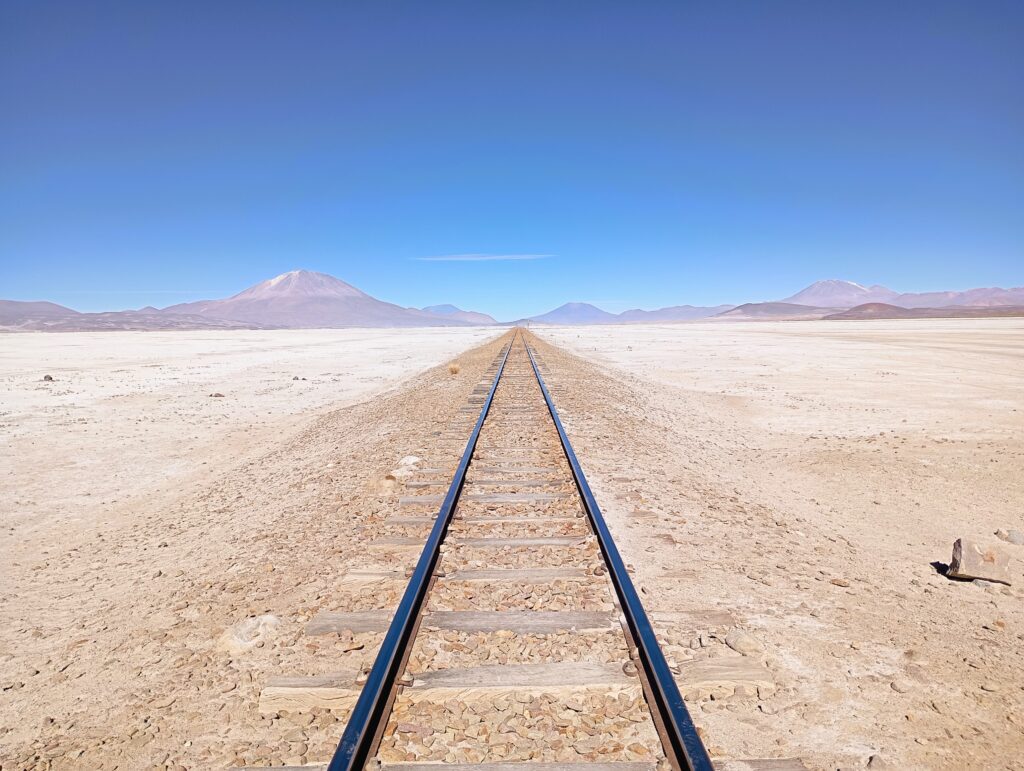
Visiting Salar de Uyuni means entering a remote environment, where distances, silence and the absence of landmarks change the way space is perceived. The immense scale of the salt flat and the isolation of the area make the experience very different from a typical excursion.
Depending on the starting point and the itinerary chosen, a visit can range from just a few hours on the salt flat to a multi-day journey through one of the most remote regions of Bolivia. In this case, off-road travel, long distances and limited access to services are all part of the experience, just as much as the extraordinary landscapes encountered along the way.
Regardless of the season and the type of visit, Salar de Uyuni requires adaptability and curiosity: it is a remote environment where nature sets the pace of the experience.
How to get to Salar de Uyuni
There are several ways to visit Salar de Uyuni, and the best option depends mainly on how much time you have and the type of trip you are planning. Some itineraries focus exclusively on the salt flat, while others also include a journey across the Bolivian Altiplano and its main natural attractions.
From Uyuni
The city of Uyuni is the main gateway to the salar. From here, it is possible to join both one-day excursions, mainly focused on visiting the salt flat, and three-day itineraries that cross the Bolivian Altiplano, either returning to Uyuni or continuing to San Pedro de Atacama, Chile. Some agencies also offer two-day alternatives, with different programmes depending on the operator. A one-day excursion is ideal for those with limited time, while multi-day itineraries allow travellers to explore high-altitude lagoons, geysers and the deserts of southern Bolivia.
From San Pedro de Atacama
Salar de Uyuni can also be reached from San Pedro de Atacama, Chile. The classic itinerary lasts three days and crosses the Bolivian Altiplano before reaching the salar. It is an ideal option for those who want to combine the two countries in a single itinerary and turn the connection between Chile and Bolivia into a true journey of exploration. For travellers who prefer to return to San Pedro de Atacama, a four-day version is also available. The final day is mainly dedicated to the return journey, with just one additional stop along the way.
From Tupiza
Less known than the routes departing from Uyuni and San Pedro de Atacama, the itinerary starting in Tupiza, southern Bolivia, reaches Salar de Uyuni in four days, crossing landscapes that differ from the San Pedro route during the first part of the journey. The two routes then merge and continue through the main attractions of the Altiplano before reaching the salar.
When to Visit: Seasons and the Mirror Effect
Salar de Uyuni can be visited year-round, but the landscape changes significantly depending on the season. There is no single best time to visit: it all depends on the type of experience you want to have.
During the dry season, generally from May to November, the salar appears as a vast white expanse covered by a thick crust of salt. This is the ideal time to appreciate its immense scale and observe the characteristic natural geometric patterns created by salt crystallisation. The weather is also generally more stable, and roads are easier to travel, making the journey more straightforward. However, this period coincides with the austral winter, when temperatures on the Altiplano can drop significantly, especially at night, reaching around -15 to -20 °C.
During the rainy season, typically from December to March, part of the surface is covered by a layer of water. Under these conditions, the famous mirror effect appears, reflecting the sky and creating a particularly spectacular landscape. However, the extent of the flooding varies from year to year depending on rainfall, so it is not possible to predict exactly when the Salar will be covered with water or how extensive the flooding will be.
When water levels are high, some areas of the salar may also become temporarily inaccessible. For example, Incahuasi Island is often excluded from itineraries during this season. Routes may also be modified, salt hotels are generally not operating, and weather conditions can make the journey less predictable. Finally, if the sky is cloudy or it rains during your visit to the salar, the famous mirror effect may not be visible.
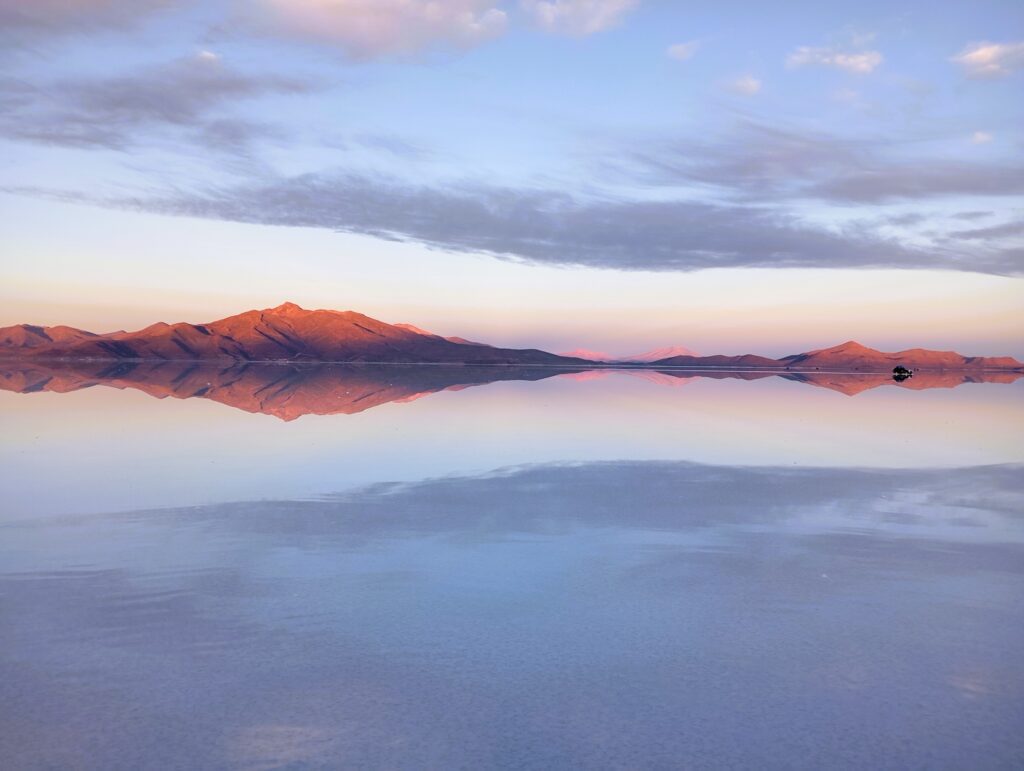
For this reason, there is no single best time to visit Salar de Uyuni. The choice mainly depends on the type of landscape you want to experience and the compromises you are willing to accept: those who dream of seeing the famous mirror effect should plan their trip during the rainy season, while those who prefer more stable conditions and fewer limitations when visiting the salar should consider the dry season.
For travellers hoping to see the mirror effect, the months at the end of the rainy season, such as March, can be a good compromise: the salar is usually still covered with water, but rainfall tends to decrease and weather conditions may become more stable. The following months, such as April and May, can also offer a particularly interesting experience, as depending on the conditions of the year, some areas may still be flooded while others are already dry, allowing visitors to experience both sides of Salar de Uyuni during the same trip. From July to October, the Salar is completely dry, but it should be considered that this period also brings the lowest temperatures of the year.
Altitude and acclimatisation
One of the most important factors to consider when planning a trip to Salar de Uyuni is the altitude. The salt flat itself lies at around 3,600 metres above sea level, but itineraries across the Bolivian Altiplano often reach much higher elevations, climbing to approximately 5,000 metres at the Sol de Mañana Geysers.
Altitude affects everyone differently. Some people experience little or no discomfort, while others may feel more fatigued, especially during the first few days. Headaches, tiredness, shortness of breath, difficulty sleeping and increased sensitivity to physical exertion are among the most common symptoms of mal de puna (altitude sickness).
For this reason, it is important to arrive well prepared and not underestimate the environmental conditions. Taking things at a slower pace, staying well hydrated and avoiding strenuous activity during the first few days can help your body adjust gradually to the altitude.
It is also advisable to spend a few days at high altitude before travelling to Salar de Uyuni, especially if you are arriving directly from a low-altitude destination.
During organised tours, it is common for coca tea to be available, a traditional drink from the Altiplano that is widely consumed by travellers to help cope with the effects of high altitude. In addition, the 4x4 vehicles used by the most reliable tour operators are generally equipped with a first aid kit and an oxygen cylinder for emergencies.
What to See and How Many Days You Need
At first glance, it might seem that a longer tour means spending more time on Salar de Uyuni itself. In reality, this is not the case. Regardless of the itinerary you choose, time spent on the salt flat is generally limited to one day. The difference between a one-, three- or four-day tour is therefore not the amount of time spent on the salar, but everything you see before and after. Today, many different itineraries and tour lengths are available, but the ones described below are the most classic and widely offered.
Map of the main routes to visit Salar de Uyuni

One day: Salar de Uyuni
One-day excursions generally depart from the city of Uyuni around 10 AM and include the main attractions of the Salar and its surroundings. The itinerary usually includes the Train Cemetery, the village of Colchani, where salt extracted from the salar is processed, the first salt hotel, now converted into a museum, the Flag Island and the Dakar Monument. The rest of the day is dedicated to exploring the salt flat, with stops for photographs and videos. When water levels allow, the tour also includes a visit to Incahuasi Island, an island covered with giant cacti that rises in the middle of the salt flat and offers one of the most beautiful viewpoints over the entire salar. Many tours end with sunset on the salt flat, one of the most spectacular moments of the day.
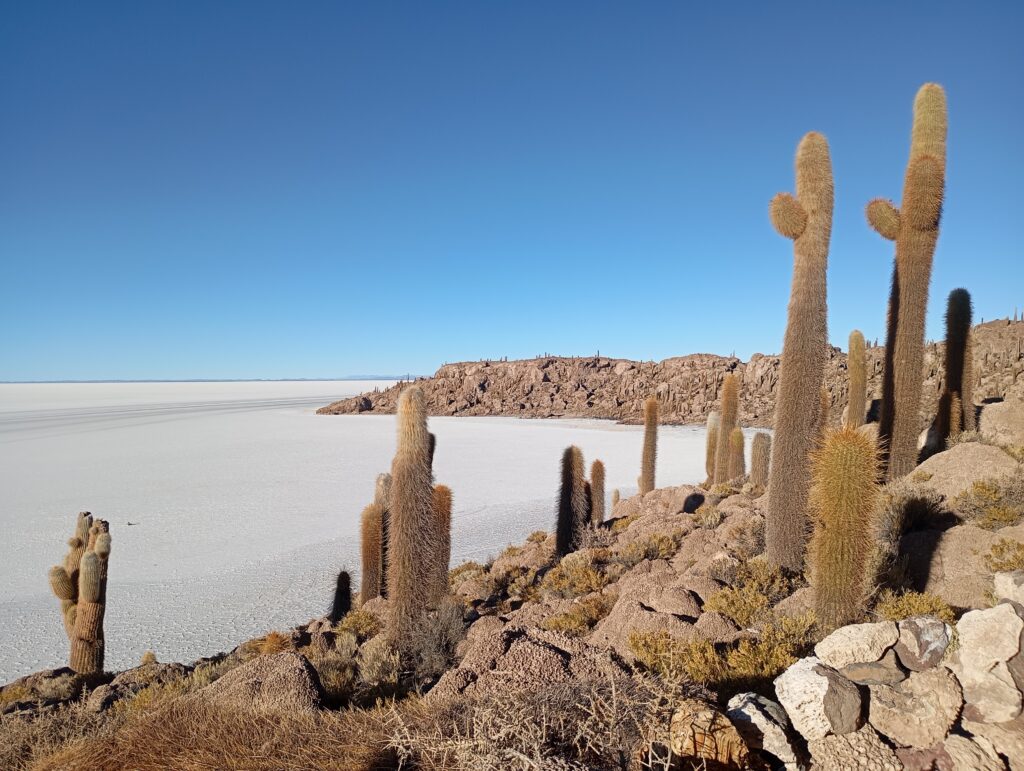 Isla Incahuasi
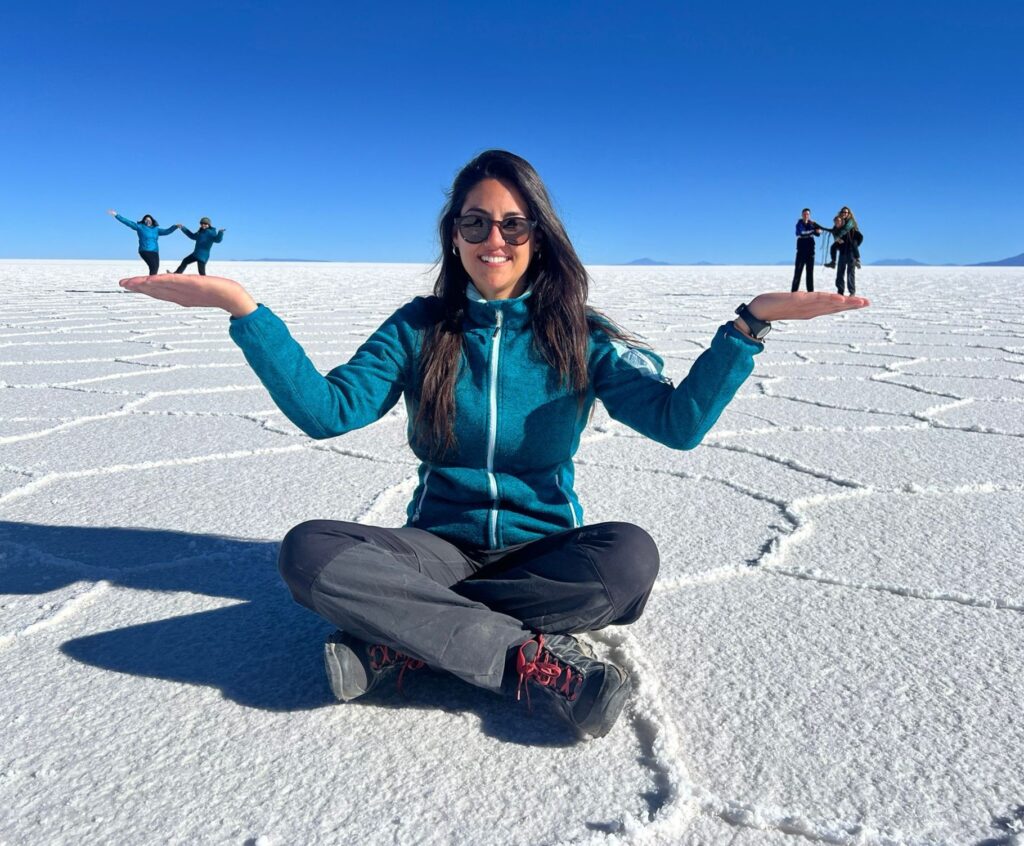 Perspective shot on the Salar de Uyuni
Some agencies offer alternative itineraries, such as stargazing before returning to Uyuni late in the evening, or two-day tours with an overnight stay in a salt hotel. In the latter case, there is no standard programme: some tours include sunrise on the Salar the following morning before returning to Uyuni, while others include additional visits to small villages, archaeological sites or short excursions into the Altiplano. If this option interests you, it is advisable to check the itinerary proposed by each agency.
Three or four days: Altiplano and Salar de Uyuni
From Uyuni
Three-day tours departing from Uyuni combine a visit to the Salar with an exploration of the southern Bolivian Altiplano.
The first day generally follows the same itinerary as one-day tours, with an overnight stay in a salt hotel (when available).
On the second day, the journey continues towards the viewpoint of Ollagüe Volcano, Cañapa and Hedionda Lagoons, Siloli Desert, Arbol de Piedra and Laguna Colorada. Some agencies include an overnight stay in basic lodges near the lagoon, while others continue as far as Termas de Polques, where it is possible to spend the night.
The third day is dedicated to the final part of the itinerary, including Sol de Mañana Geysers, Termas de Polques, Salvador Dalí Desert, and Laguna Verde and Laguna Blanca, located at the foot of Licancabur Volcano. From here, the route continues towards Uyuni, usually passing through San Cristóbal, or towards the Chilean border for travellers continuing their journey to San Pedro de Atacama. Those who spend the night at Termas de Polques visit the final highlights of the itinerary, including Laguna Verde and Laguna Blanca, before returning to Uyuni or transferring to Chile.
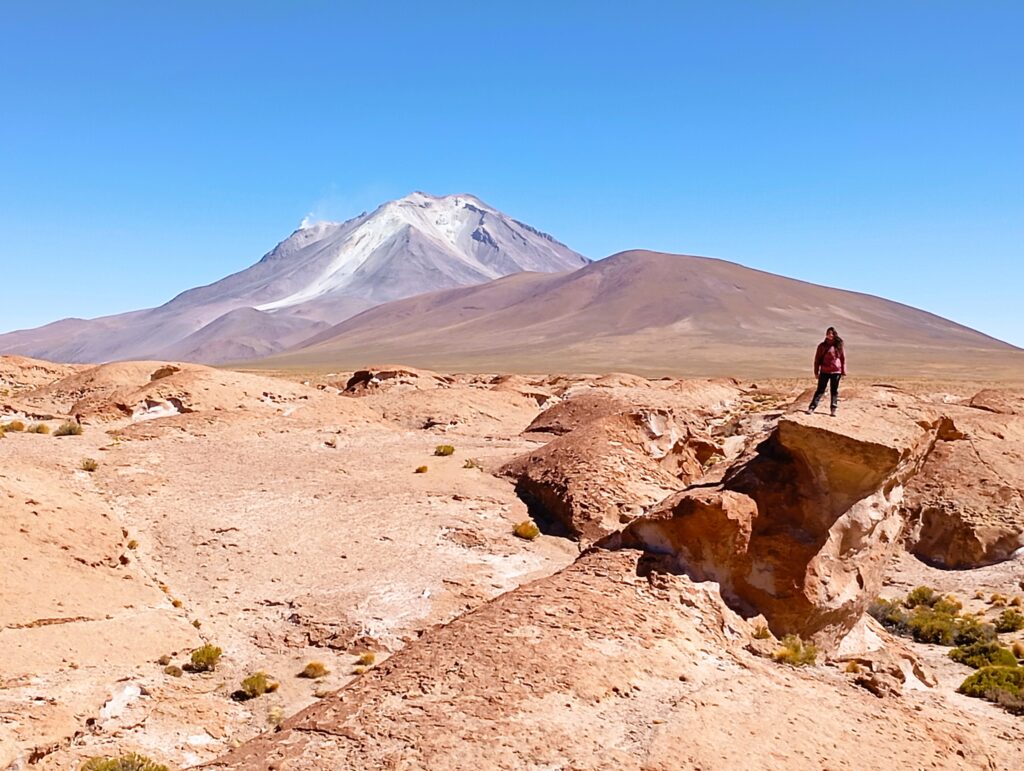 Mirador de Ollagüe
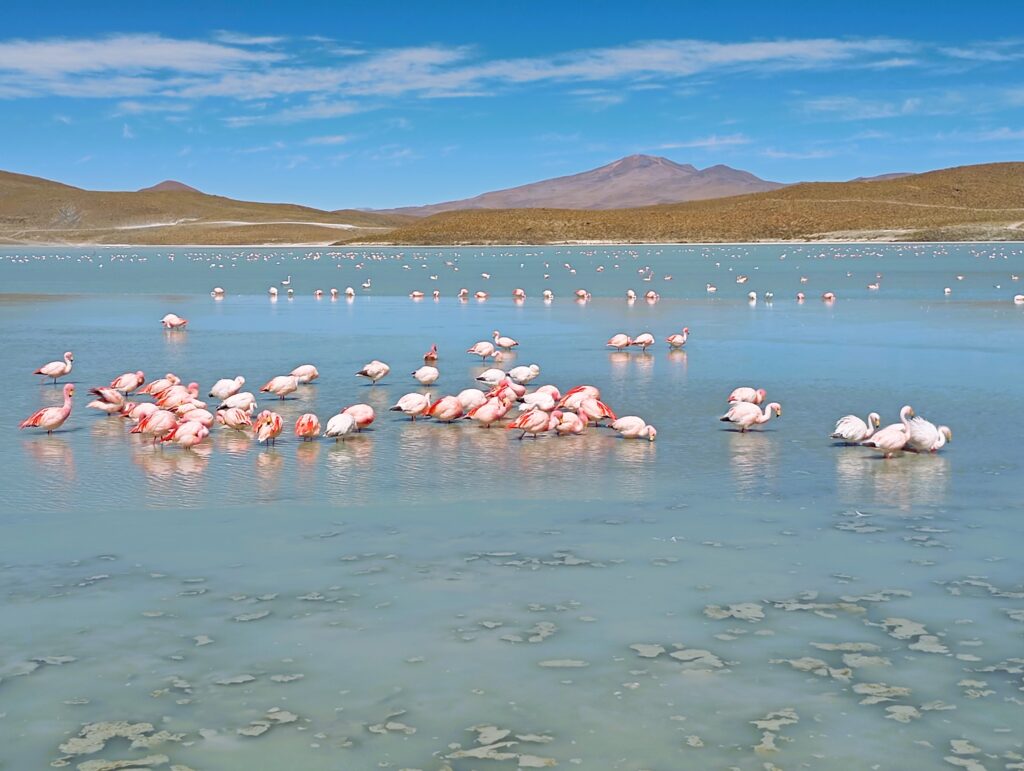 Laguna Cañapa
From San Pedro de Atacama (Chile)
Three-day tours departing from San Pedro de Atacama cross the Altiplano towards Salar de Uyuni, generally following the route in the opposite direction to itineraries departing from Uyuni. However, the central part of the journey may vary depending on the agency, with two main routes that merge before reaching the salt flat.
The first day is dedicated to entering Bolivia through the Hito Cajón border crossing and visiting Eduardo Avaroa National Reserve. The itinerary generally includes Laguna Blanca and Laguna Verde, Salvador Dalí Desert, Termas de Polques, Sol de Mañana Geysers and Laguna Colorada. From Laguna Colorada, the route can follow two different paths: some agencies continue towards Villa Mar, where the first night is spent, while others continue towards Villa Alota, visiting Arbol de Piedra and Laguna Hedionda along the way.
Those who spend the night in Villa Mar visit the Copa del Mundo and Cammello rock formations, Laguna Catal and Anaconda Canyon on the second day, while those who stay in Villa Alota visit places such as Valley of the Rocks, Sora Canyon and Laguna Negra. Both routes then merge again on the main road towards San Agustín and Julaca, with the second night spent in a salt hotel (when available).
The third day is dedicated to visiting Salar de Uyuni, following the classic one-day tour itinerary but in reverse. Departing in the early morning allows travellers to experience sunrise on the salt flat, a different experience from the sunset seen on tours departing from Uyuni, but equally spectacular. The tour ends in the early afternoon with arrival in Uyuni.
It is possible to add a fourth day for the return journey to San Pedro de Atacama, with a stop in San Cristóbal before the third night’s accommodation and the transfer back to Chile.
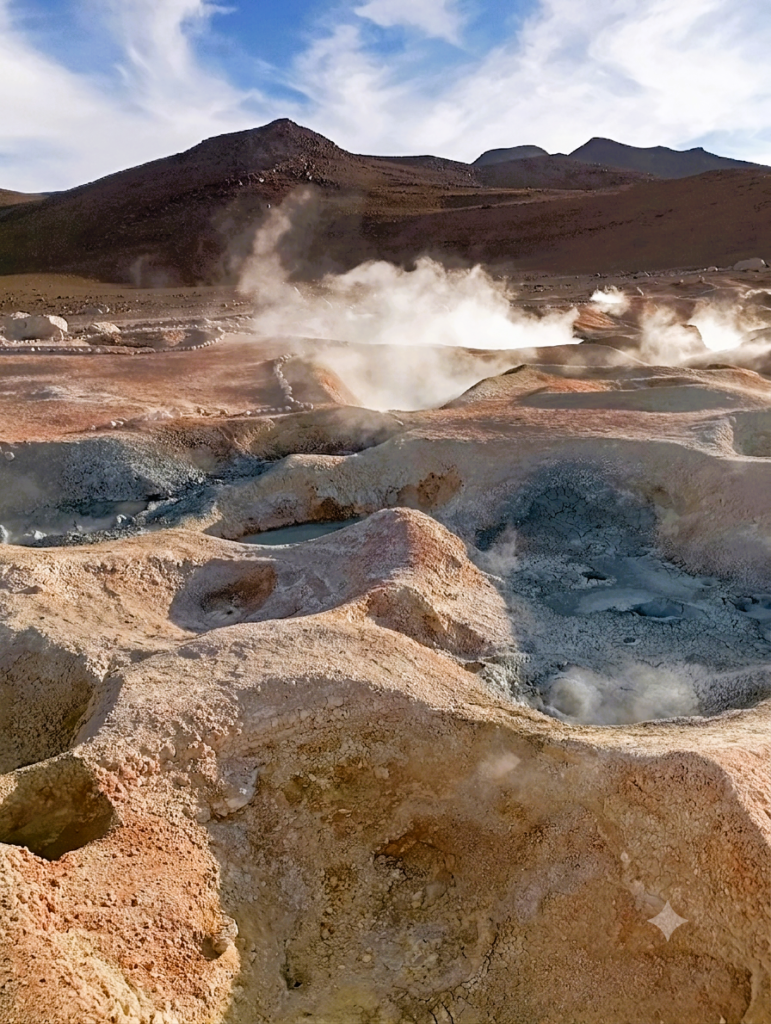 Geyser Sol de Mañana
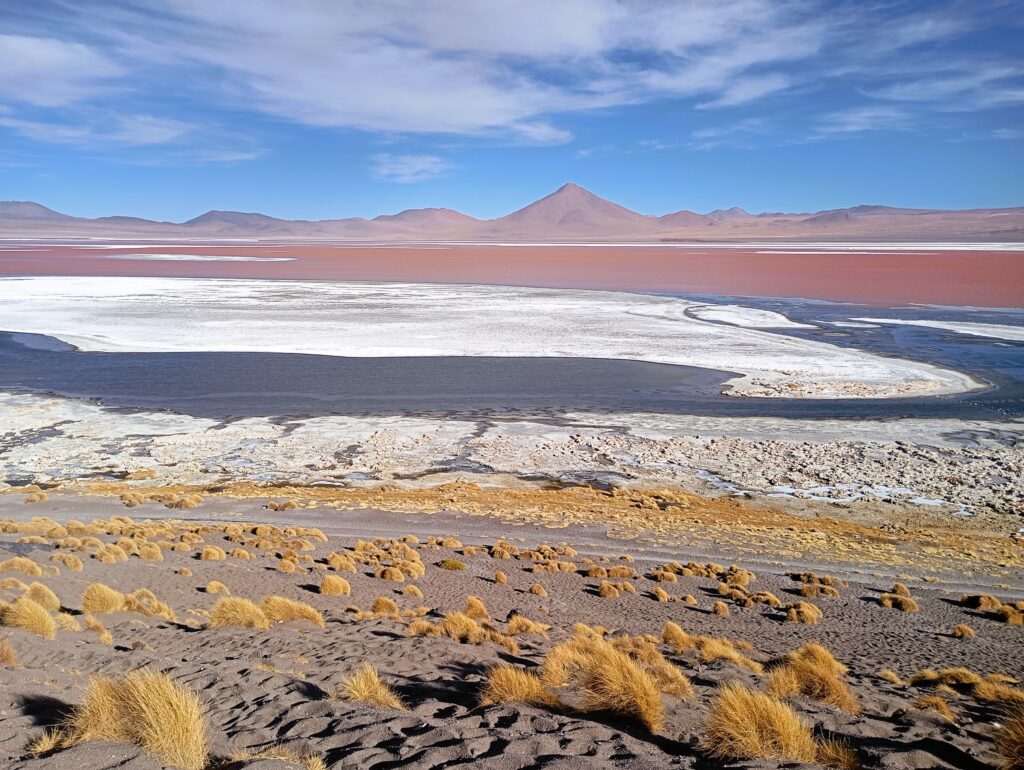 Laguna Colorada
From Tupiza
Less travelled than the routes departing from Uyuni and San Pedro de Atacama, the itinerary from Tupiza, in southern Bolivia, reaches Salar de Uyuni in four days, crossing an even more remote part of the Bolivian Altiplano. The main difference compared to the other routes is the first day, which is dedicated to the landscapes of the Lípez region before joining the classic route towards the Salar.
On the first day, the journey passes through places such as Quebrada de Palala, El Sillar and Ciudad del Encanto, characterised by spectacular geological formations shaped by erosion. The route then continues through small villages to Quetena, where the first night is spent.
The second day enters Eduardo Avaroa National Reserve, following an itinerary very similar to the tours departing from San Pedro de Atacama. The day generally includes Laguna Kollpa, Termas de Polques, Laguna Verde and Laguna Blanca, Salvador Dalí Desert, Sol de Mañana Geysers and Laguna Colorada. The night is spent in basic lodges near the lagoon.
On the third day, the route continues through Siloli Desert, with visits to Arbol de Piedra and several lagoons such as Laguna Kara, Laguna Kachi and Laguna Negra. After passing through small settlements such as San Agustín and Julaca, the third night is spent in a salt hotel (when available).
The fourth day is dedicated to visiting Salar de Uyuni, following the same itinerary as one-day tours but in reverse. Departing in the early morning allows travellers to experience sunrise on the salt flat, and the tour ends with arrival in Uyuni in the early afternoon.
For those wishing to return to Tupiza, some agencies include a return transfer from Uyuni, which is approximately a three-hour drive away.
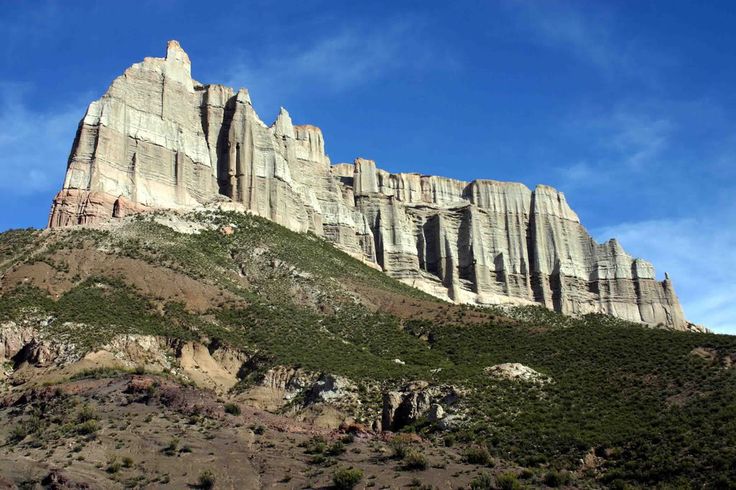 El Sillar
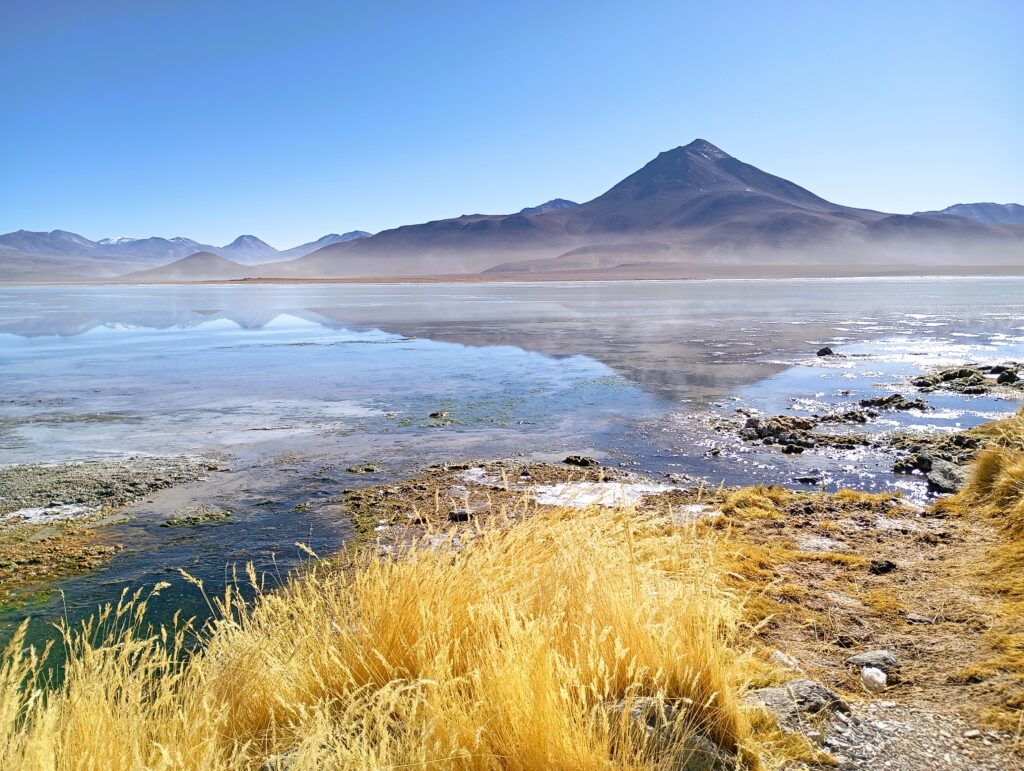 Laguna Blanca
How to plan your visit to Salar de Uyuni
Organised tour or independent travel
Although it is technically possible to visit Salar de Uyuni independently, this option is strongly discouraged. The lack of landmarks and signs, the vast distances and the almost complete absence of phone coverage make it easy to lose your way, especially inside the salar. In addition, high altitude, low temperatures and harsh environmental conditions can affect physical performance and decision-making, making it even more important to rely on people who know the area well. During the rainy season, conditions become even more challenging: the layer of water can hide the surface of the salar, and the ojos del salar, natural openings found in different areas, can pose an additional risk for those unfamiliar with the terrain.
For this reason, unless you are a very experienced traveller with proper preparation and the necessary equipment for remote environments, it is advisable to rely on a local agency. Guides and drivers travel these routes on a daily basis, know the territory well and are prepared to deal with challenges related to altitude, weather conditions and road conditions.
Shared or private tour
The tours can be shared or private, and the difference is not only in the price but also in the level of comfort they offer.
Shared tours are the most budget-friendly option and generally include six passengers in a 4×4 Jeep. Private tours, on the other hand, offer greater flexibility and allow you to customize the itinerary to some extent according to your needs. It is important to keep in mind, however, that there are fixed travel times and mandatory stops, so the possibilities for changes are not unlimited.
Even if you choose a more comfortable option, it is important to have the right expectations. The days involve long drives on unpaved roads, the route crosses very remote areas, and facilities are limited. A good degree of adaptability is therefore essential, regardless of which type of tour you choose.
How to choose a tour operator
Prices can vary significantly from one agency to another, even for the same itinerary.
In many cases, a higher price reflects newer vehicles, better accommodation and more careful organisation. Some very budget tours, for example, include extremely basic lodgings, where running water may be unavailable and hygiene standards are limited to the essentials.
That said, a higher price does not always guarantee better quality. Before booking, it is therefore advisable to choose experienced agencies and carefully read reviews from other travellers. It can be difficult to evaluate aspects such as vehicle conditions, driver experience or the accommodation where you will spend the night in advance, especially because many agencies rely on different local providers. The experiences of people who have already taken the tour remain one of the most useful tools for making an informed choice.
⟶ If you prefer to avoid comparing numerous agencies on your own and would rather rely on selected local operators, I can help you organise your Salar de Uyuni tour that best suits your trip. After gathering information about your itinerary and your needs, I will take care of selecting the option I consider most suitable for you.
Where to start
There is no single best starting point for visiting Salar de Uyuni. The choice mainly depends on where you are before reaching the salar, how much time you have available and the type of itinerary you are planning.
If you are already travelling in Bolivia, starting from Uyuni is generally the most logical and practical option. Those who have a few extra days and enjoy overland journeys can also consider departing from Tupiza. This itinerary crosses less-visited areas and allows you to discover landscapes that differ from the classic route from Uyuni, but it requires more time. Unlike tours departing from Uyuni, those from Tupiza run less frequently and, especially during the low season, may not depart every day. If you choose this route, it is therefore advisable to book in advance: arriving in Tupiza without a plan may mean having to wait several days before departure. When I arrived in Tupiza, for example, the first available tour was scheduled to leave four days later.
If you are already in the north of Chile, you can choose to depart directly from San Pedro de Atacama. Many travellers also consider the option of reaching Uyuni by bus and starting the tour from Bolivia, but personally, I believe that in most cases, if you are already in San Pedro, departing from here is the best solution.
The main reason is logistics. Reaching Uyuni by bus from San Pedro means leaving in the middle of the night (generally around 3:00 AM), facing a journey of approximately 12 hours and crossing the Ollagüe border, a crossing also used by commercial traffic and not exclusively dedicated to tourists like Hito Cajón. Arrival in Uyuni is generally in the afternoon, making it necessary to spend one night in the city before starting the tour the following day. In practice, you travel a long distance by bus only to then take a three-day itinerary crossing the Bolivian Altiplano and eventually heading back towards the Chilean border.
Starting from San Pedro de Atacama, on the other hand, the journey begins directly along this route, allowing you to cross the Altiplano from the first day and avoid transfers that add time and complexity to the organisation. Reaching Uyuni by bus can make sense if you only want to do a one-day excursion to the salar, but if you have several days available, I strongly recommend including the landscapes of the Bolivian Altiplano as well.
From an economic point of view, purchasing the tour directly in Bolivia is generally a slightly cheaper option. However, the price difference should be evaluated by also considering the cost of the bus transfer, the additional night in Uyuni before departure and the meals needed while waiting. Moreover, in my experience, tours departing from San Pedro tend to offer more comfortable accommodation on average, while some agencies operating from Uyuni include stays in very basic lodges, where bringing a sleeping bag may be necessary.
For this reason, if you are already in San Pedro de Atacama, I recommend booking a tour departing from here: it allows you to optimise your time, cross the Altiplano along the route and avoid additional transfers that do not add value to the itinerary.
Costs and travel budget
Indicative tour prices
The cost of a Salar de Uyuni tour can vary significantly depending on the starting point, duration and level of comfort included. The lowest prices generally correspond to shared tours with basic services, while more comfortable or private options can have considerably higher costs.
Below you can find some indicative price ranges for standard shared tours:
| Starting point | Duration | Indicative price |
|---|---|---|
| Uyuni | 1 day | 60-100 USD |
| Uyuni | 3 days | 160-280 USD |
| San Pedro de Atacama | 3 days | 190-300 USD |
| San Pedro de Atacama | 4 days (with return to Chile) | 230-350 USD |
| Tupiza | 4 days | 250-350 USD |
Prices can also vary depending on the season, the agency chosen and current availability. Booking directly on site may sometimes allow you to find lower rates than those indicated, especially when there are last-minute spots available.
What is generally included in a tour
The included services can vary from one agency to another, but most shared tours generally include:
- 4×4 Jeep transportation;
- driver-guide (usually Spanish-speaking);
- fuel and all transfers included in the itinerary;
- all meals during the tour;
- overnight stays in the planned accommodations;
- water and drinks during meals;
- for tours departing from San Pedro de Atacama, transfer to the Chile-Bolivia border (always to be confirmed).
Some agencies also offer additional services, either included in the price or available at an extra cost, which can affect the level of comfort and safety during the journey, such as: hot water in the accommodations where you stay; Wi-Fi connection in the lodges; oxygen tank and first aid kit on board the vehicle; meals for specific dietary requirements.
Extra costs to consider
Most shared tours DO NOT include some expenses that should be considered when planning your final budget, such as:
- entrance fees for the attractions included in the itinerary (for a total of 210 BOB, depending on the route chosen);
- drinks outside of meals;
- any private room accommodation;
- an English-speaking guide or guides in other languages;
- towels and personal items;
- rubber boots during the rainy season;
- a sleeping bag, if required (only by some agencies or for certain types of accommodation);
- use of bathrooms along the route;
- souvenirs and tips.
Some services, such as private rooms, guides in other languages, and the rental of towels, boots or sleeping bags, may be available as extras with some agencies. It is therefore advisable to always check what is included in the chosen price and which services can be added, as not all agencies offer the same options.
Useful information before departure
Who should avoid this experience
The altitude, harsh climate and travel conditions make this experience not suitable for everyone. It is generally not recommended for children under 6 years old, people over 70 years old, those with cardiovascular or respiratory conditions, and those with significant mobility limitations. However, each situation should be evaluated individually based on personal health conditions and previous experience with high altitude. In case of doubts or specific health concerns, it is always advisable to consult your doctor before departure.
For multi-day tours, it is also important to keep in mind that you will travel long distances on unpaved roads, cross very remote areas and have access to limited services. To fully enjoy the experience, a good spirit of adaptation is therefore essential.
What to pack and how to organise your luggage
The weather conditions in the Salar de Uyuni and the Bolivian Altiplano can change quickly throughout the day. Due to the high altitude, temperatures are often very cold in the early morning and after sunset, even during the Southern Hemisphere summer. In summer, minimum temperatures are usually around 5 °C, while in winter they can drop to -15/-20 °C. The wind can also be particularly strong. For this reason, it is best to dress in layers and bring warm clothing, as well as hiking shoes or comfortable footwear suitable for walking on unpaved terrain.
Essential items also include sunscreen, sunglasses, a hat and lip balm. At these altitudes, the sun is particularly strong, and on the salt flats, light reflected off the salt further increases exposure to UV rays.
If your itinerary includes a stop at Termas de Polques, don’t forget your swimsuit and towel. It is also a good idea to bring enough water for at least the first day, along with a few snacks; you will be able to buy more water and food along the way later on.
There are few toilets along the way, and they are often very basic. In some of the more remote areas of the Altiplano, you may need to resort to the so-called “Inca toilet”, meaning going to the bathroom outdoors. For this reason, it is useful to bring toilet paper and anything else you may need.
Opportunities to charge phones, cameras and other electronic devices are quite limited along the route. Cold temperatures and high altitude can also significantly reduce battery life. It is therefore a good idea to bring at least one fully charged power bank. Accommodations generally have Type A and Type C electrical outlets, so an adapter is not necessary for most European devices.
You can bring a drone, but its use is not permitted within protected areas such as the Reserva Nacional de Fauna Andina Eduardo Avaroa. In the Salar de Uyuni, however, drones are generally allowed, provided you follow the driver’s instructions and take the conditions at the time into account, particularly the wind and dust.
During multi-day tours, luggage is transported on the roof of the Jeep and is generally only accessible in the evening upon arrival at the accommodations. For this reason, it is useful to organise your luggage into two separate bags: a daypack to keep with you throughout the day, containing everything you need (water, sunscreen, camera, medication, etc.), and a main bag with spare clothes, towels and anything else you will only need once you arrive at the accommodations.
Documents and travel insurance
To enter Bolivia, you need a passport with at least six months of remaining validity. Citizens of most European countries do not need a tourist visa to enter Bolivia. However, entry requirements can change and some nationalities are subject to different regulations. Before departure, it is therefore always advisable to check the updated requirements according to your country of citizenship.
If the tour starts from San Pedro de Atacama, it is also essential to keep the document issued by the Policía de Investigaciones (PDI) when entering Chile, as it must be handed over at the border during the exit procedures from the country.
To enter Bolivia, it is also necessary to complete the Formulario 250. In most cases, the agency will provide all the necessary instructions for filling it out, but it is always advisable to check this procedure before departure.
Tours generally include only the mandatory vehicle insurance, which covers medical expenses resulting from any accidents during transportation. For all other situations, such as cancellations, delays, lost luggage or other unexpected events, it is advisable to purchase personal travel insurance before departure.
Money
During the tour, it is essential to have some cash in the local currency, Bolivian bolivianos (BOB), especially for entrance fees, drinks, toilets, small purchases and any unexpected expenses. In the Bolivian Altiplano, there are virtually no opportunities to withdraw or exchange money, so it is important to plan ahead before setting off.
If you are already in Bolivia, it is advisable to get bolivianos in major cities such as Uyuni, La Paz, Sucre or Potosí. In general, exchanging cash in Bolivia often offers better rates than withdrawing money with a card. For this reason, whenever possible, it is preferable to exchange cash rather than rely on ATMs. If you are leaving from San Pedro de Atacama, you can exchange Chilean pesos or other currencies before the tour at one of the exchange offices in town.
Both Bolivia and Chile have exchange offices where you can change a range of currencies, including euros, US dollars, Chilean pesos and other South American currencies. Payment cards, however, are not accepted everywhere, especially in less touristy areas, so it is best not to rely exclusively on electronic payments. Some agencies may also offer better rates when tours are paid for in cash, so it can be worth checking this option before booking.
Internet access
During the tours, phone signal and internet access are virtually unavailable due to the remote areas you travel through and the lack of mobile coverage, especially in the Altiplano.
The only times you may be able to get online are when you arrive at your accommodation, as some places offer Wi-Fi. However, the connection can be slow, unstable or unavailable altogether, particularly in more isolated areas.
If you are travelling from and returning to San Pedro de Atacama, there is therefore no need to buy a Bolivian SIM card. If your trip continues through Bolivia, you can consider getting a local SIM card or eSIM once you arrive in Uyuni.
This temporary disconnection is part of the travel experience: for a few days, you will cross completely remote landscapes, far from infrastructure and the constant connectivity of everyday life.
Salar de Uyuni is an extraordinary destination, but to fully appreciate it, it requires adaptability and awareness of the conditions you will encounter along the way. Long distances, high altitude, unpaved roads and limited services are all part of the experience. Preparing in advance, planning your journey carefully and setting the right expectations will allow you to make the most of this adventure.
It is also important to remember that this is a natural environment subject to changing conditions: some phenomena, such as the mirror effect of the salar during the rainy season, depend entirely on the weather conditions at the time and cannot be guaranteed. Likewise, rain, wind or road conditions may require changes to the itinerary.
Are you planning a trip to Bolivia or northern Chile?
If, in addition to Salar de Uyuni, you need help planning your itinerary, I can help you create a tailor-made trip or offer personalised travel advice based on your needs.